Translated version published by Penguin in 2016
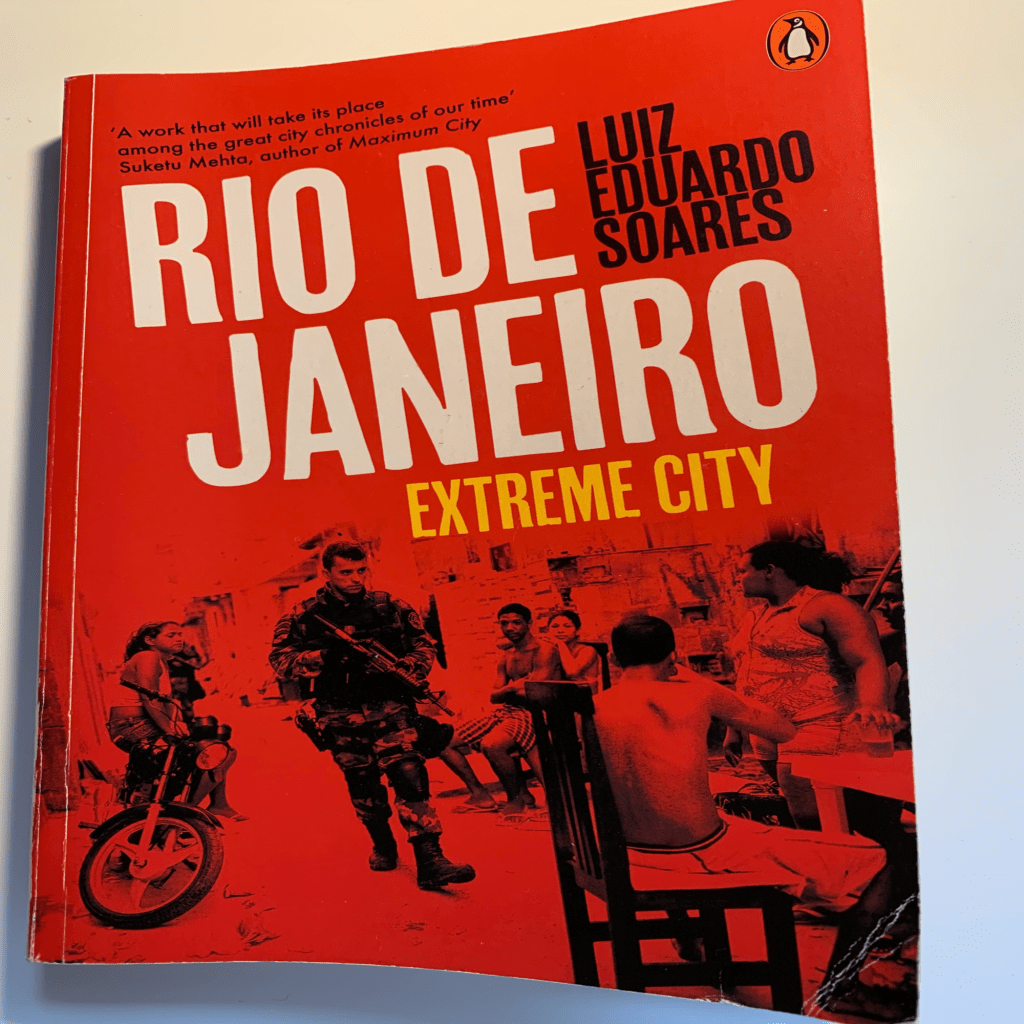
This is a brutally honest portrayal of corruption in Brazil; an engrossing read in which we have to give credit to the author for his pull no punches approach, as he lays bare some of the most extreme examples of wanton police violence and brazen political wrongdoing.
In many ways this book is an unofficial autobiography, as the author shares glimpses into his personal life like going to his first football match with his father or hosting a party for thirteen Swedish friends. These insights give us a view into the author’s life and makes his perspective warmer and easier to relate to. But it also creates a historical and political backdrop, contextualising key events that took place before, during and after the military dictatorship of 1964-1985. What’s more, the events take place in Rio de Janeiro the city that had been Brazil’s capital until 1960, just four years before the coup d’état, that would usher in the dictatorship.
You have to admire the sheer courage of Soares to put into words some outrageous examples of abuses of power that he witnessed first-hand as a politician at local and national level. What is revealing is just the staggering depth of the problems that exist in Rio and Brazil more broadly; engrained problems that have existed for generations that have no easy solutions. And whilst Soares himself tries bravely to confront these issues head on (and this respect he acts as a whistle blower) he is more often than not met with a brick wall of defiance, warning him not to overstep the mark. His optimism and ambition to change things for the better in his country are frequently met with cynicism and aggression urging him not to challenge the status quo.
One of the most harrowing and hard to read episodes describes the systematic torture of the 21 year old student Dulce Pandolfi at the hands of government operatives during the military dictatorship. The author spares us no details as he lays bare the horrors of state authorised persecution of its own citizens, in an atmosphere where freedom of speech had been done away with and censorship of the press meant that crimes of that nature went unreported.
“When the Brazilian dictatorship was in full stride, between 1969 and 1974, there was no need to hurry. The torturers had all the time in the world to sink the blade of terror into their victims’ flesh.” (p.47)
The physical and psychological abuse that the victims were subjected to was truly horrendous and the author’s attention to detail demonstrates his desire for as much light as possible to be shed on this darkest of episodes in Brazilian history.
Another enlightening section describes the time the author is called into a Rio favela, when he was serving as a local politician, in an attempt to calm an impending riot. He is undertaking this Herculean task when a police helicopter flies overhead to disperse the crowd and in the process displaying behaviour deliberately intended to provoke and intimidate the masses in a shameful abuse of power. Soares’ exasperation and rage are clear to see as he witnesses acts of corruption on a shocking scale.
“The machine [helicopter] and its addendum – the laughing gunman acting out an aerial massacre – are designed to intimidate. Especially when they ascend and descend above the heads of the crowd, the roar of blades drowning out the other sounds.” (p.91)
The penultimate chapter discusses the June 2013 protests (which took place all over Brazil) and describes how the author unwittingly got caught up in the Rio march. Whilst the protests were originally about the rise in the price of transport fares, they soon turned into something much more generic in nature and were organised largely online via social media. Whilst there were a myriad of reasons why people came out onto the streets, the exorbitant amounts of money spent on major sporting events like the Football World Cup and the summer Olympics was a recurrent theme. But the incohesive and inhomogeneous nature of these manifestations was perhaps their most striking element. The author makes the following observation whilst still on the march itself.
“I opened the recorder app on my cell phone and said the following: anyone who tries to capture the demonstrations of 20 June 2013 in a nutshell risks wasting what was perhaps most essential to it: its dispersiveness.” (p.253)
They were a spontaneous outpouring of grievances that had no greater message per se. It was a cry of discontent at large from the bowels of society, releasing years of pent up frustration and anger. At its peak the author estimated that there were about one million people thronging down the President Vargas Avenue in central Rio venting their discontent about the state and its modus operandi.
A connection is made to a similar rally that took place some thirty years earlier that the author attended in almost exactly the same part of the city in April 1984 showing that Rio had remained an important place of political manifestation throughout this time despite losing its status as capital.
“Rio de Janeiro, though stripped of its capital status in 1960, continued to figure as the ultimate symbol of the nation.”(p.227)
However the 1984 protests had a clear message with clear goals, namely the end of the dictatorship and the immediate reinstatement of democracy. The impact the dictatorship had on people was also laid bare, especially on young people at the time.
“On 10 April 1984 I was exhausted. I’d had as much as I could take of the authoritarian regime. The dictatorship had desiccated two thirds of my life. From 1964 to 1984, all we had had was twenty years of fear and censorship.” (p. 242)
With an almost depressingly level of predictability the 2013 protests ended in scenes of indiscriminate police violence as they attempted to break up the crowd. Rubber bullets were fired and tear gas incendiaries were launched at participants who were trying to get home, as people were hounded across the city in an attempt to reach safety. In an unfathomable paradox the police ended up provoking chaos and destruction rather than quelling it.
Soares paints a brutal picture of his home city; brutal in its honesty and bravely to recount some of the appalling things he has been witness to. The account is made more sincere as it is a highly personal one and the authors’ directness makes for compelling reading. His talent for writing wonderfully brings to life scenes and snapshots from Brazil’s most famous city; at times you can almost feel the heat of the carioca summer or smell the grilled meat on the barbecue in the back yard, such it the vitality of his prose. Credit should also be given to Anthony Doyle for an illuminating translation from the original Portuguese.
Soares brilliantly shares his myriad of emotions that are engendered through his everyday life in Brazilian society: love, joy, surprise, desperation, incredulity, despair. The rollercoaster ride is extreme and the jolts and shocks are uncomfortable. But this only adds to the depth and breadth of this fascinating book which is characterised by an unflinching level of honesty in the face of significant opposition. In putting his head above the parapet Soares confronts some of the most challenging issues faced by Brazilian society and his meticulous attention to detail means that the horrors of the past cannot be forgotten.
This book would appeal to readers who would like to know more about the recent history of Brazil’s most iconic city and also that of Brazil as a whole. The internal issues highlighted by Soares are still playing out in Brazilian society today and understanding them can help us contextualise the challenges and machinations of this deeply complex country.


 WilliamGAFrost
Hi William, it was a pleasure to meet you on screen the other day! Unfortunately, I have a limited interest in things Brazilian (too much to do with my other interests, three foreign languages and music studies). Perhaps we’ll meet again in a Spanish context. Regards, Francine
LikeLike
Hi Francine, it was great to meet you at the conversation club. It was good getting to know you even for a short time! Thank you very much for your comment I really appreciate it. The book is awesome and I definitely recommend it. Yes hopefully see you again. Best wishes, William.
LikeLike