By Lilia M. Schwarcz and Helosia M. Starling
Published by Allen Lane, translated edition in 2018.
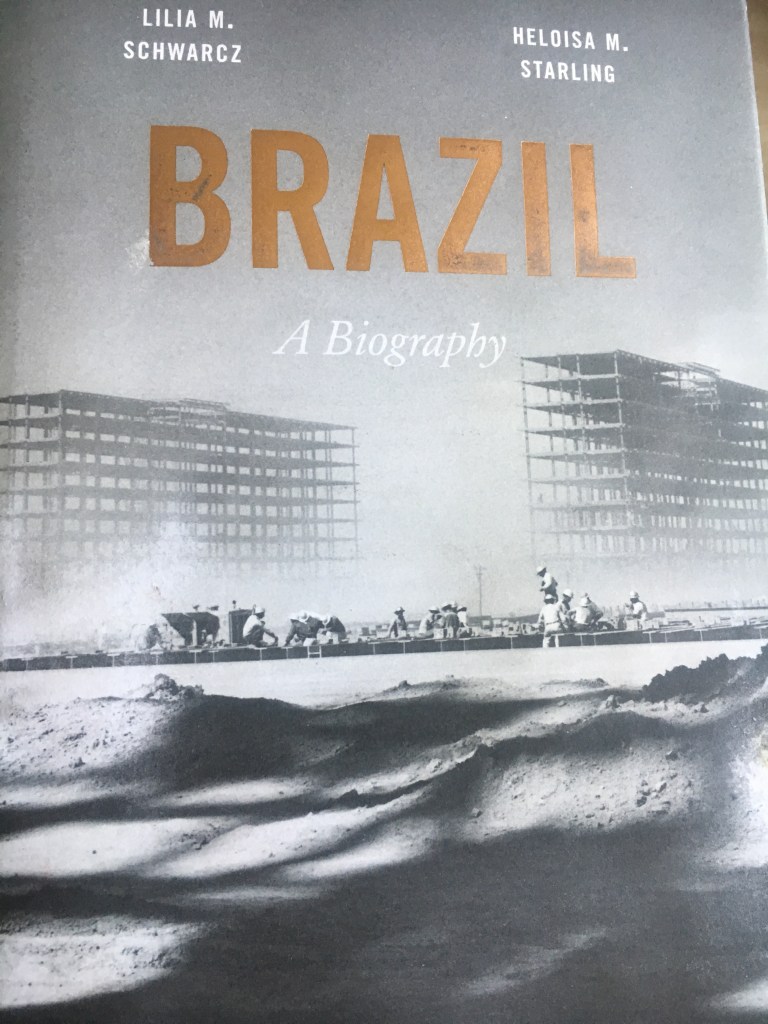
Brazil’s past is covered in meticulous yet readable detail in this stunning new history of South America’s largest country. Schwarcz and Starling have produced an enjoyable read that takes the reader through the various stages of Brazil’s history, right from the early days of discovery and colonisation in the early sixteenth century, to the impeachment of Dilma Rousseff in 2016 and its consequences for the modern day country. These two historians have managed to produce an in depth narrative that manages to seamlessly combine social and political history.
This is a large undertaking at 602 pages, however the text manages to keep the reader’s attention and is engaging throughout. The perspective from which the book is written is objective and fair and seeks to give as accurate an account of the past as possible. Key themes such as the transatlantic slave trade, the Portuguese Royal family’s arrival in Rio de Janeiro in 1808, the Brazilian Empire and the republican revolution of 1889 are all dealt with in a thorough way. The authors demonstrate a high level of research and the detail provided facilitates an easier understanding of what is a relatively complicated history.
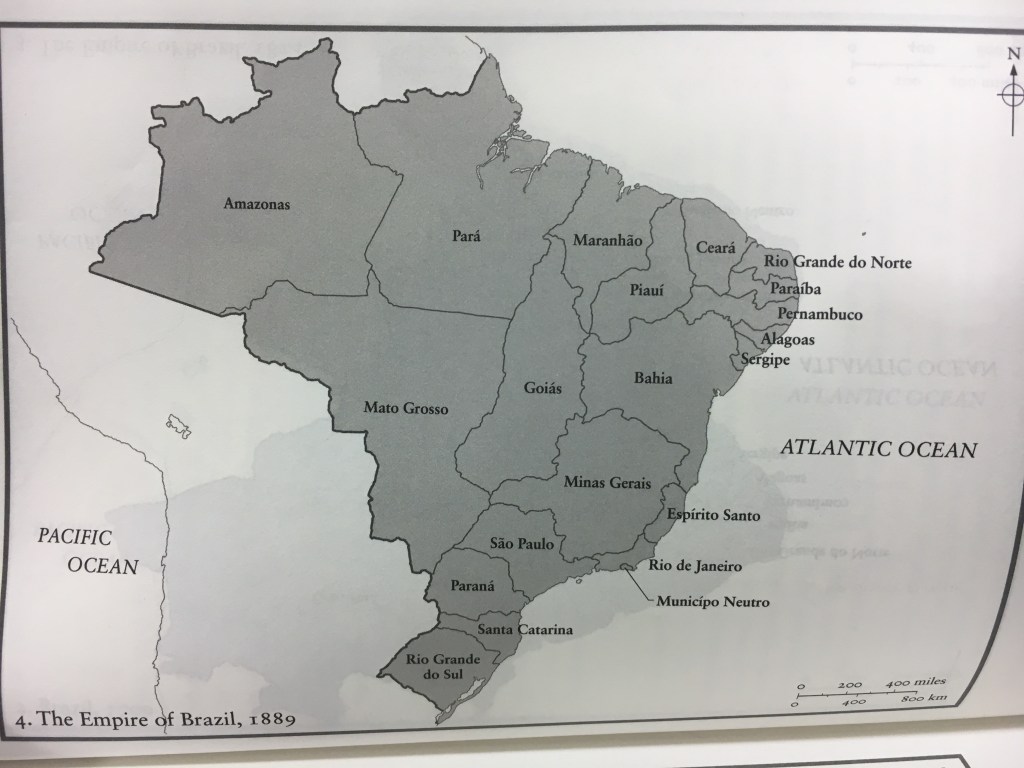
A series of five maps, demonstrating how the territory of Brazil has changed since its early days of colonization, to the present day, aid the reader in understanding the geographical environment in which the historical events take place which is extremely useful. They also show just how big the country became over a period of 500 years; indeed, with the exception of the region of Cisplatina, which makes up the current nation of Uruguay, Brazil did nothing but increase in size right up until the 1910’s. This is a demonstration of the truly continental size of the country. There are also a series of colour prints of relevant paintings and photos that illustrate some of the key episodes considered by the authors.
Brazil has had a turbulent past but the authors do not seek to shy away from these difficult episodes, on the contrary they face them head on. Thorny issues such as national identity are discussed.
“Since Brazil has been Brasil – since the country first created its identity as a nation – there has been a long history of internal conflict, violence, attempts at self- government and demands for equality – accompanied by the gradual development of human rights and citizenship. “
P.577
They are equally as unflinching when it comes to the gruesome subject of slavery and its legacy. This is a topic that is becoming more and more discussed in Brazil as an integral part of its past. In a subchapter entitled “Slavery is synonymous with violence” (p.85) the historians state.
“The repetitive, arduous, exhausting work on the plantations was in itself a form of violence. This forced labour, betokening as it did the authority of the master, instilled a constant feeling of dread, as well as terror of the collective punishments that were frequently applied.”
p.86
Brazil imported the largest amount of captives from the African continent than any other nation, between 4 and 5 million slaves over four centuries of the trade. With this in mind it is good to see that the topic is now being examined in more detail and with more frequency.
Dealing with more recent times, the military dictatorship of 1964-1985 is dealt with in a clear and balanced way, exposing some of the techniques used by the military hierarchy to justify their repressive and at times violent means of government.
“The AI-1 [First Institutional Act] also allowed the military police to arrest people en masse, close off streets, conduct individual house-to-house searches, all of which occurred in 1964… when around 50,000 people were detained in a deployment that police baptized ‘Operation Cleanup’.”
p.523
The crimes committed by the state during this dark period in the country’s history are discussed in a courageous way; this is still a traumatic topic for many Brazilians who lived through that regime and many of the atrocities are still coming to light today. The historians also relate the struggle that Brazil has faced emerging out of military rule and how democracy has had many setbacks since 1985. This included erratic economic policy and an instable currency, the nadir of which was the decision of the then president, Fernando Collor, to freeze all citizens’ bank accounts, which had a disastrous effect.
“In the banks, part of the money [80%] in checking accounts was blocked… the amount withheld would be returned in eighteen months… Twenty years later 890,000 individual court cases and 1,030 class actions are still waiting for a judicial decision.”
p.570
Mr Collor later (in 1992) resigned on the eve of an impeachment trial for corruption and misuse of public funds, an episode which demonstrated how long and complicated the road back to a semblance of stability would be for Brazil. In this analysis of the modern era, the historians manage to bridge the gap between history and political science giving the book an all encompassing feel, that gives the content a broader appeal.
The strength of this “biography” is its brutal honesty. The historians are clearly trying to uncover uncomfortable truths about the past that they feel need to be given fresh airtime in an attempt to make sense of the present day nation. Whilst this makes for a harrowing read at times, it is however worthwhile for the clarity and insight that it provides.
Brazilian history is not simple to understand and is also not a linear evolution, however the authors guide the reader through each era with a level of clarity and expertise so that light is shed onto even the most complicated episodes. In this respect is it recommended for Brazilianists as well as to readers unfamiliar with the topic. This is a masterful work written by two consummate academics at the top of their game. Single volume histories of Brazil are also relatively rare making this one even more significant. This is an excellent book of exceptionally high quality and therefore an unmissable read for anyone interested in the past or present of Brazil.
 WilliamGAFrost